About
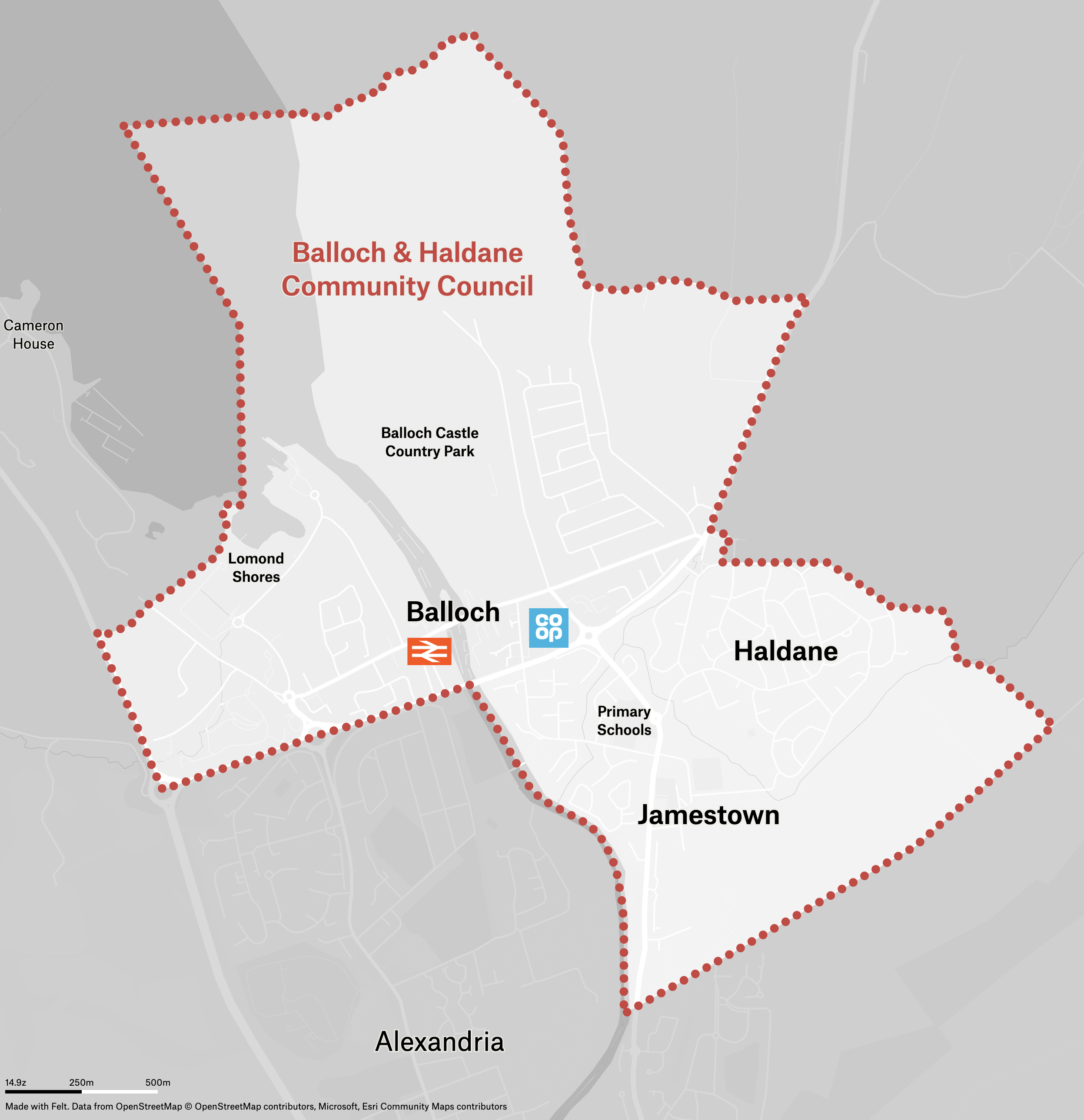
When complete, our new community-led Plan will cover the Balloch and Haldane Community Council area.
The area includes Balloch, Haldane and Jamestown together with small areas of agricultural land to the east and west. Tullichewan and Alexandria are not part of the area.
The boundary is shown on the map.
What area will the plan cover?
Community-led plans are produced by local communities to steer their own future. They are a way for communities to set the agenda for their future, rather than wait for others to do things.
Preparing a community-led plan takes time and effort, and there is no guarantee that everything will be implemented. But it will give us new opportunities and influence to shape our community’s future that we wouldn’t otherwise have.
What is community-led planning?
There are different kinds of community-led plans.
Local Place Plans were introduced recently by the Scottish Government as a way for communities to influence planning policy for their area. You can find out more about them lower down this page.
Community Action Plans have been around for many years, and normally focus on action that the community can take itself. Find out more about them and see some examples lower down this page.
Some communities have combined Community Action Plans and Local Place Plans into one plan, which covers everything to do with their “place”. For example, housing, transport and community facilities, cutting across community action, planning policy and public services. The idea is that it is easier and cheaper than doing two separate plans, as well as being less confusing for residents.
Our intention is to do a combined Plan for Balloch and Haldane.
What do COMBINED community-led plans look like?
More and more communities around Scotland have started to produce combined Local Place Plans and Community Action Plans since the new legislation came into force in 2023.
The examples below give you a flavour of what these combined Plans can cover. Each involved the same planner/ facilitator who is supporting our plan.
Each plan is different, because each community has distinct needs. Balloch and Haldane’s plan will be different again, but the general approach is similar.
KINLOCHLEVEN Local Place Plan
Like Balloch and Haldane, Kinlochleven has an industrial past in a stunning setting. When the smelter closed 20 years ago, the village saw some regeneration and investment - but it stalled after a few years, and more action is needed.
Kinlochleven Local Place Plan was registered in March 2025, representing a new dawn for the community.
After false starts in previous years, the Plan lays out a new future based on community action and more productive relationships with the main local landowner and the public sector.
Producing the Plan achieved consensus locally on what to focus on, and gave the community a much stronger position to get what they needed with the main landowner and the public sector.
There were also some quick wins, like reopening the Aluminium Story tourist attraction in the centre of the village.
GARNOCK VALLEY LOCAL PLACE PLAN
This Local Place Plan for Beith, Dalry and Kilbirnie in North Ayrshire shows what ambitious local communities can aspire to.
At the heart of the plan is the community and public sector working together for common cause - achieving community aspirations, which in turn national agendas like jobs, health and climate action.
The plan recently picked up a special national award from Scotland Loves Local - in recognition of the collaborative nature of the work.
The team is now forging ahead with delivery. It will take time and effort, but the plan has good support from which to build.
The Garnock Valley may be bigger, but the approach is the same in Balloch and Haldane. So it’s interesting to look at how they want about their plan and what it contains.
Find out more at www.ourgarnockvalley.net
Local Place Plans
Each of the examples above functions partly as Local Place Plans, which are part of new planning legislation that enables communities to identify their local priorities and develop a plan to tackle them.
The National Park and West Dunbartonshire Council, as our two planning authorities, are legally obliged to take account of registered Local Place Plans as they prepare their new Local Development Plans.
The map shows how our area is split between the two authorities.

The Scottish Government says that Local Place Plans “offer the opportunity for a community-led, collaborative approach to creating great local places… effectively empowering communities to play a proactive role in defining the future of their places” (Circular 1/2022, paragraph 3).
You can find out more about Local Place Plans on this Scottish Government webpage, on Local Place Place information webpages produced by the National Park and West Dunbartonshire Council.
Although Local Place Plans must include proposals for the development and use of land, they can include other things that the community might want to achieve too - for example improving public transport, more community activities, access to affordable homes, renewable heat and power, or whatever the community thinks is important.
There is no legal requirement for the Council or the National Park to take account of anything else in Local Place Plans beyond planning issues. But experience suggests that they can be a good opportunity to raise other issues.
Community Action Plans
Community Action Plans have been around for many years. They normally focus on action that the community can take itself.
Here in Balloch and Haldane, we prepared a Community Action Plan ourselves back in 2014.
Find out more about Community Action Plans on this Scottish Community Development Centre webpage.
Generally, other communities have found that preparing their own plan can:
Build consensus within the community and with the public and private sectors, helping things to get done rather than stuck in debate.
Support community action - for example, helping community projects to get funding.
Improve public services, influencing services like ducation, health, transport and planning.
Below, you can see three example of Community Action Plans and the impacts that they have had.

Langholm Community Plan
Langholm’s 10-year Community Plan, produced in 2020, led immediately to funding for two community workers who put together the successful community buyout of the local estate from the local landowner, Buccleuch, a year later.

Crianlarich into Action
Crianlarich’s 2011 community action plan led to an immediate grant of £15,000 to upgrade the public toilets, a long lease of the derelict station yard in the village centre by the Council to the community for a park, picnic tables and car parking, and - after a few years of hard work - a £200,000 path network next to the village on forestry land for locals and visitors.

Huntly: Room to Thrive
The community’s 2018 and 2022 plans resulted in 6 months rent free lease of a closed RBS bank on the town square as a community space.
That then led to community purchase of the bank and two vacant shops on the square a year later, and their refurbishment and reopening as business premises.
You can read more about what the community has achieved on their development trust’s website.